Lean Six Sigma Green Belt Training Course
DURATION
5 daysCPD
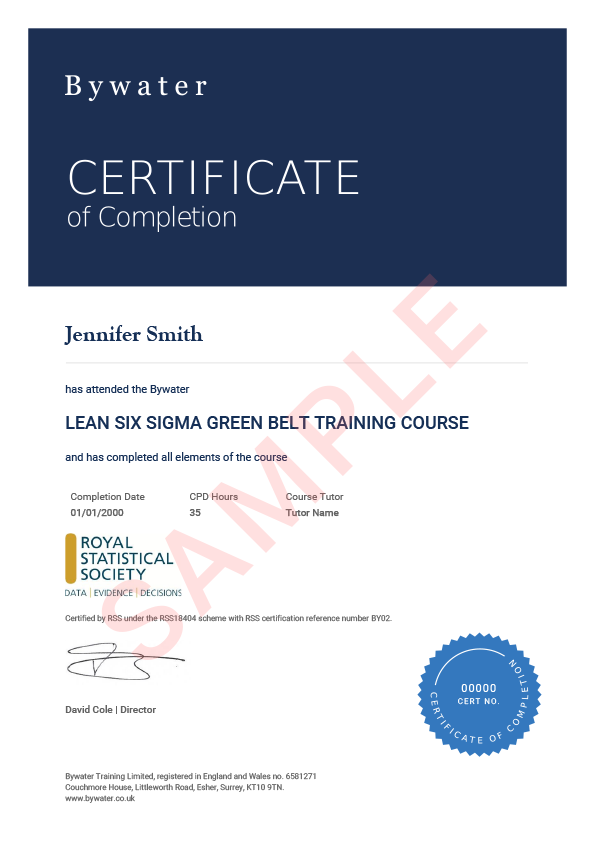
Equivalent to 35 hoursCERTIFICATES
All delegates will receive a certificate on completion.DELIVERY OPTIONS


Course Approval

This certified Lean Six Sigma Green Belt training course provides attendees with the knowledge and skills to participate at Green Belt level in Lean Six Sigma projects.
The inclusion of practical workshops and exercises gives delegates the opportunity to develop and practise their Lean Six Sigma skills.
By the end of the course attendees will be able to identify and undertake improvement projects that deliver outcomes such as reduced waste, greater productivity, enhanced quality, increased customer satisfaction and lower operational costs.
The training is led by expert tutors, including Master Black Belts who have been instrumental in the development of ISO 18404, the standard for Lean and Six Sigma.
Click to read the Lean Six Sigma Green Belt course flyer.
- looking to improve business performance by removing the causes of defects and as a result increase customer satisfaction
- wishing to use Lean Six Sigma methodologies to optimise processes and reduce variation
- working in organisations seeking to increase productivity
- responsible for continuous improvement within the organisation
- responsible for supporting/monitoring the success of Six Sigma improvement or organisational improvement projects of all types
This course incorporates our Lean Six Sigma Yellow Belt training course, meaning no prior knowledge is required.
On completion of the course attendees will receive a recognised Lean Six Sigma Green Belt certificate.
Please note, this course includes a high degree of mathematics and statistics as this is a fundamental part of the Six Sigma approach. Laptops with Excel, or equivalent, are required for this course.
- introduction to Lean and Six Sigma
- Lean, Six Sigma and Lean Six Sigma competencies, organisational benefits and business process improvement
- process thinking and the Lean Six Sigma toolkit
- define – measure – analyse – improve – control (DMAIC) project management
- stakeholder management
- lean principles
- process mapping
- Kanban and Kaizen
- value stream mapping (VSM)
- change management
- risk management
- presentation and reporting
- sustainability
- statistics, data and problem solving
- data acquisition for analysis
- practical problem solving, including root cause analysis (RCA)
- statistical concepts:
- manipulation of data
- sampling
- frequency distributions
- measures of variation
- hypothesis testing
- Six Sigma tools:
- measurement system analysis (MSA)
- statistical process control (SPC)
- Day 1
- Registration and Introductions
- Module 1
- ISO 18404:2015 & Certification Requirements
- Introduction to Lean, Six Sigma & Lean Six Sigma Roles
- Module 2 Lean Six Sigma & the Relationship to Quality, Efficiency and Productivity
- Module 3 Process Thinking and the (Lean) Six Sigma Toolkit
- Exercise 1 Claims Authorisation Process
- CLOSE
- Day 2
- Module 4 DMAIC(T) Project Management & Decision Making
- Module 5 Interpersonal & Team Leadership Skills Stakeholder Management
- Module 6 Creativity Tools & Defining the Project Mission
- Exercise 2 Creating a Project Charter
- Exercise 3 Applying the Alternatives & Challenge approaches
- Exercise 4 Scout
- Module 7 Principle & Practice of Lean Value Stream Analysis
- Exercise 5 Construct a Value Stream Mapping
- CLOSE
- Day 3
- Module 8 Change Management
- Exercise 6 Syndicate Exercise: Successfully Managing Change for Lean Six Sigma
- Module 9 Leadership and Motivation
- Exercise 7 Development and Independence Level Analysis form
- Exercise 8 Belbin questionnaire & Conflict Questionnaire
- Module 10 Customer Focus
- Exercise 9 House of Quality
- Module 11 Risk Management
- Exercise 10 Identify & Evaluate Risks Associated with a Green Belt Project Proposal
- Module 12 Sustainability & Control
- Module 13 Presentation & Reporting Skills
- CLOSE
- Day 4
- Module 14 Numeracy
- Module 15 Data Acquisition for Analysis
- Exercise 11 Appropriate Data
- Module 16 Statistical Concepts
- Sampling
- Frequency Distributions
- Confidence Intervals & Confidence Levels
- Hypothesis Testing
- Exercise 12 Tutor Led Exercises
- Module 17 Practical Problem Solving
- Types of problem
- Root Cause Analysis
- Localisation
- CLOSE
- Day 5
- Module 18 Six Sigma Tools
- Regression and Correlation
- Designed Experiments
- Analysis of Variance
- Measurement System Analysis
- Module 19 Statistical Software Use
- Summary
- CLOSE
- Module 18 Six Sigma Tools
During the course there will be a morning and afternoon break with additional screen breaks provided for Virtual Classroom courses. In addition, a one hour break is provided for lunch.
The teaching to Yellow Belt level enables students to understand:
- the principles and benefits of Lean Six Sigma
- the Lean Six Sigma roles at various levels
- the Lean Six Sigma toolkit
- how to quantify opportunities for improvement
Extending the Yellow Belt level onto the Green Belt teaches students to:
- use Six Sigma tools such as regression and correlation, analysis of variance, measurement system analysis, standards and tolerances
- apply statistical concepts such as sampling methods and distributions, and use statistical software
- apply the DMAIC methodology to improvement projects
- reduce and control variation within processes
- identify and evaluate risks associated with Green Belt projects
- mentor others on process improvement methods
- confidently acquire and sample data to identify and quantify opportunities for improvement
- formulate a project charter and stakeholder analysis for a Lean Six Sigma project
- identify and manage stakeholder interests
The course is certified by the Royal Statistical Society (RSS).
Following the course, delegates who wish to progress to become a certified Six Sigma Black Belt can attend our 5-day Six Sigma Green Belt to Black Belt training course.
Upcoming course dates




Yes, this popular 5-day course combines our introductory Yellow Belt training course with the more advanced skills required for Green Belt activities. That means you can start the week with little knowledge of Six Sigma, and finish it ready to take part in improvement projects at Green Belt level.
If you only need an overview of Six Sigma at this stage, you may like to consider our 2-day Yellow Belt training course, which will give you a clear understanding of the aims, methodologies and tools of the Six Sigma approach.
As individuals achieve higher levels in the Six Sigma belt programme, they will learn new skills and take on new responsibilities within Six Sigma projects.
Green Belts usually seek to implement improvement opportunities in their current field of work. They are expected to differentiate between different types of problems and select an appropriate approach from the Lean Six Sigma ‘toolkit’ to address them. Green Belts generally work with local management to identify and quantify opportunities for improvement, and may coach less experienced and knowledgeable Yellow Belts on process improvement methods and activities.
In some instances, Green Belts may work under the direction of a Six Sigma Black Belt, or a Master Black Belt.
DMAIC is the underpinning Six Sigma improvement project methodology. It is a process-based improvement approach with 5 phases:
- Define - identify the process to improve
- Measure - eliminate guess work
- Analyse - identify the cause of the problem
- Improve - generate solutions to remove the problem
- Control - implement a control system
Yes, this course is certified by the Royal Statistical Society, and your certificate will reflect the high quality of our professional tutoring. The certificate will be sent to you after the course for you to share with interested parties, including colleagues, employers and LinkedIn associates.
The course is equivalent to 35 hours CPD.
As the UK’s leading independent business training provider, Bywater has been an Royal Statistical Society (RSS) Approved Training Organisation since 2021. That means that all our Six Sigma training courses have been assessed and confirmed as delivering high-quality content through tutors who are both experienced in their field and experts in training.
We offer a wide range of complementary Six Sigma training courses, designed to meet your needs at every stage of your Six Sigma journey, from introduction to expert skills. Take the steps from Yellow Belt through Green Belt to Black Belt one stage at a time, or combine 2 or 3 stages in a single course for faster progression.
As with all our training, you can choose to attend face-to-face training or visit our Virtual Classroom for online training. All our courses are live and highly interactive, giving you the opportunity to share experiences, talk to the tutor, and take part in practical exercises with your delegate group.
Bywater has been providing professional training for 40 years, and runs a full calendar of courses and venues throughout the UK and online globally.
Customer reviews
Swift Admin Solutions|24th Mar, 2026
Highway Assurance|23rd Mar, 2026
Sika Limited|12th Mar, 2026
Canary Wharf Group Plc|11th Mar, 2026
Vinci Construction Management Ltd.|9th Mar, 2026
Blu-3 UK Ltd|4th Mar, 2026
Roband Electronics Ltd|3rd Mar, 2026
Cegos Uk|26th Feb, 2026
GE Aerospace|24th Feb, 2026
Senior Aerospace Weston|16th Feb, 2026
Elekta Limited|13th Feb, 2026
Hertility Health|12th Feb, 2026